


Latest project: In the process of making 8 Barn Owl nest boxes for the 100 acre farm. The design is below, adding a 'exercise deck' on the American version. Cut the material to size yesterday and later today. Assembling at the farm next week and installing in March when I can paint the outside of the box. Plan to put them all on 16'x4"x4" With 3.5' in the dirt, adding the predator guard at the bottom.


Some GROK AI data mining work -
Yes, you can absolutely attract barn owls (Tyto alba) to your 100-acre wooded property at Coshocton, OH, using nesting boxes. Barn owls are cavity-nesters that readily adopt well-designed boxes, especially in areas with ample prey like rodents attracted to your food plots and the edges of strip mine ponds. Your setup sounds ideal: the open, grassy, and wetland-like habitats from the ponds and plots provide excellent hunting grounds, while the woods offer perching spots for fledglings. Barn owls thrive on small mammals (e.g., voles, mice) that flourish in such mixed edges, and your location in Coshocton County—part of Ohio's rural, agricultural landscape—has confirmed barn owl presence, though populations are state-threatened and could benefit from boxes like yours.
Barn owls in Ohio prefer open grasslands or meadows for hunting but can "commute" across woods to prey sources, making your property a strong fit. They hunt within 2-3 km (1-2 miles) of nests, so boxes here could cover the full 100 acres. Success rates for new boxes are around 50%, but your food-rich site boosts that. Install in late winter/early spring (Feb-Mar) ahead of breeding (Mar-Jun in OH), and monitor quietly to avoid disturbance.
Placement is key: boxes must mimic natural cavities (dark, secluded) with clear flight paths to open hunting areas. From your image, I can see the ~1-mile-wide red-outlined boundary (roughly rectangular, oriented NW-SE) with scattered ponds (dark blue/green areas), wooded patches (darker brown), open/grassy zones (lighter tan), food plots (possible yellowish/greenish strips), and roads. The central pond cluster (~0.2-0.3 miles across) and southern open areas stand out as prime.
Prioritize edges where woods meet open/grassland or ponds—owls hunt over water and fields but nest away from dense forest to avoid predators like great horned owls. Avoid deep woods, roadsides (collision risk), or direct south sun (overheating). Face entrances toward open ground (e.g., fields/ponds), away from prevailing west/southwest winds in OH. Mount on poles (preferred for open views) or isolated trees; 8-15 ft high (12 ft ideal). Space boxes 50-100+ ft apart.
ODNR limited info on the Barn Owl.
2012 Update
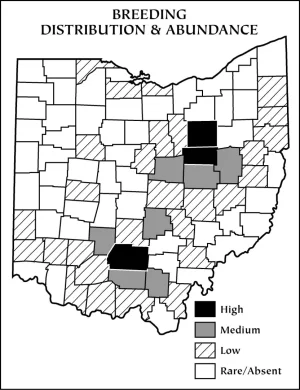
This threatened species occurs in wet meadow, hay, and lightly-grazed pasture habitats, mainly in counties along the glacial border of Ohio. The 2012 nesting season was the best on record thanks to an unusually warm winter. We started with 17 active nests by February. At the end of August there were 98 active nest sites throughout the state. Barn owls are very dependent upon meadow voles as their primary prey; consequently, nest success varies with meadow vole production, consequently, when meadow vole production is down so are the numbers of barn owl chicks that survive to fledge.
Nest Box Designs. Steve Simmons is generally the American design that most folks in the US do. I'm building 8 boxes 100% with his design adding internal batons inside for plywood support and a owlet exercise "deck" is added from the UK version as well as other US Barn Owl nest box designs..

Only change is adding 10" exercise deck across the full front. 2" below the entrance hole.


The cuts C# and the resulting lumber elements L# to keep it strait when making 8 boxes out of 3/4" CDX exterior (untreated) but the glue is water proof. CDX grade is safe for nest boxes. but you have to treat the outside if you want some longevity for your efforts and expense.

The Barn Owl Trust design our Limey Cousins use.
 www.barnowltrust.org.uk


I'll be updating as they get built/installed thru '2026. Plan to put cams watching them to see what's interested/nesting.
Some GROK AI data mining work -
Attracting Barn Owls with Nesting Boxes in Your Property
Yes, you can absolutely attract barn owls (Tyto alba) to your 100-acre wooded property at Coshocton, OH, using nesting boxes. Barn owls are cavity-nesters that readily adopt well-designed boxes, especially in areas with ample prey like rodents attracted to your food plots and the edges of strip mine ponds. Your setup sounds ideal: the open, grassy, and wetland-like habitats from the ponds and plots provide excellent hunting grounds, while the woods offer perching spots for fledglings. Barn owls thrive on small mammals (e.g., voles, mice) that flourish in such mixed edges, and your location in Coshocton County—part of Ohio's rural, agricultural landscape—has confirmed barn owl presence, though populations are state-threatened and could benefit from boxes like yours.
Barn owls in Ohio prefer open grasslands or meadows for hunting but can "commute" across woods to prey sources, making your property a strong fit. They hunt within 2-3 km (1-2 miles) of nests, so boxes here could cover the full 100 acres. Success rates for new boxes are around 50%, but your food-rich site boosts that. Install in late winter/early spring (Feb-Mar) ahead of breeding (Mar-Jun in OH), and monitor quietly to avoid disturbance.
Recommended Number of Nest Boxes
Based on conservation and pest-control guidelines, aim for 5-10 boxes across your 100 acres. This density (1 box per 10-20 acres) supports multiple breeding pairs without overcrowding, as barn owls are somewhat colonial but need space for territories. Start with 5 (one per 20 acres) and add more if occupancy reaches 70%—that's the saturation point where you've attracted all the owls the habitat can sustain. In similar Ohio setups (e.g., Amish farms with hayfields and hedgerows), this has boosted local populations.- Why this range? Too few (e.g., 1-2) might underutilize the space; too many (15+) risks competition or underuse. Studies in agricultural areas show 5-10 boxes can support 10-20 adults, fledging 20-50 young annually, consuming thousands of rodents per season.
- Factors for your site: Your ponds and plots likely concentrate rodents, so lean toward 7-8 for even coverage. If woods are dense, prioritize open edges to maximize hunting access.
Best Locations for Each Box
Placement is key: boxes must mimic natural cavities (dark, secluded) with clear flight paths to open hunting areas. From your image, I can see the ~1-mile-wide red-outlined boundary (roughly rectangular, oriented NW-SE) with scattered ponds (dark blue/green areas), wooded patches (darker brown), open/grassy zones (lighter tan), food plots (possible yellowish/greenish strips), and roads. The central pond cluster (~0.2-0.3 miles across) and southern open areas stand out as prime.
Prioritize edges where woods meet open/grassland or ponds—owls hunt over water and fields but nest away from dense forest to avoid predators like great horned owls. Avoid deep woods, roadsides (collision risk), or direct south sun (overheating). Face entrances toward open ground (e.g., fields/ponds), away from prevailing west/southwest winds in OH. Mount on poles (preferred for open views) or isolated trees; 8-15 ft high (12 ft ideal). Space boxes 50-100+ ft apart.
ODNR limited info on the Barn Owl.
2012 Update
This threatened species occurs in wet meadow, hay, and lightly-grazed pasture habitats, mainly in counties along the glacial border of Ohio. The 2012 nesting season was the best on record thanks to an unusually warm winter. We started with 17 active nests by February. At the end of August there were 98 active nest sites throughout the state. Barn owls are very dependent upon meadow voles as their primary prey; consequently, nest success varies with meadow vole production, consequently, when meadow vole production is down so are the numbers of barn owl chicks that survive to fledge.
Nest Box Designs. Steve Simmons is generally the American design that most folks in the US do. I'm building 8 boxes 100% with his design adding internal batons inside for plywood support and a owlet exercise "deck" is added from the UK version as well as other US Barn Owl nest box designs..
Only change is adding 10" exercise deck across the full front. 2" below the entrance hole.
The cuts C# and the resulting lumber elements L# to keep it strait when making 8 boxes out of 3/4" CDX exterior (untreated) but the glue is water proof. CDX grade is safe for nest boxes. but you have to treat the outside if you want some longevity for your efforts and expense.
The Barn Owl Trust design our Limey Cousins use.
Barn Owl boxes for trees - The Barn Owl Trust
Barn Owl boxes in buildings are better than nestboxes in trees. But if you have a suitable tree, tree nestboxes are much more practical than boxes on poles.
www.barnowltrust.org.uk
I'll be updating as they get built/installed thru '2026. Plan to put cams watching them to see what's interested/nesting.
Attachments
Last edited:


